


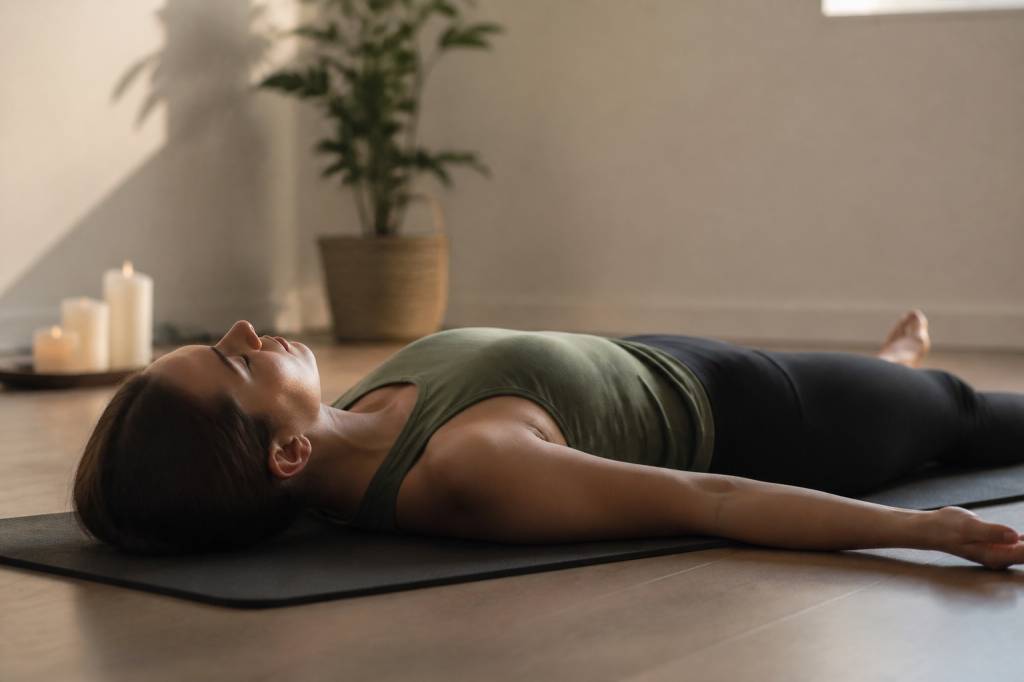
Some nights, sleep feels close enough to touch, yet somehow remains just beyond reach. The room is quiet, the lights are low, and still the mind continues its private conversation: unfinished tasks, old memories, tomorrow’s decisions. You turn the pillow, check the time, and wonder why the body is tired while the thoughts are wide awake.
Yoga Nidra offers another way in. Often translated as “yogic sleep,” it is a guided practice of deep relaxation that invites the body to rest while awareness remains gently present. You do not need to stretch, balance, or perform a perfect pose. You simply lie down, listen, and allow yourself to be carried by the rhythm of your breath.
A ten-minute practice may not solve every difficult night. But it can create a small, meaningful passage between the activity of the day and the softness of sleep. Like lowering the volume of a song, one layer at a time.
What is Yoga Nidra?
Yoga Nidra is a guided meditation traditionally practised while lying comfortably on the back. The body becomes still, while the attention moves through sensations, breath, sounds, and imagination. The aim is not to force the mind to become empty. Instead, you learn to observe without needing to fix anything.
This distinction matters. Many of us approach rest as another task to complete. We try to relax harder, sleep sooner, or stop thinking immediately. The effort itself can keep the nervous system alert. Yoga Nidra offers a gentler invitation: there is nowhere else to go, nothing to achieve, and no special state you must reach.
During the practice, you may drift between wakefulness and sleep. You may notice images, memories, sounds, or moments of complete stillness. This is normal. You do not have to remain perfectly focused. If your attention wanders, simply return to the guide’s voice or to the natural movement of your breath.
Why a ten-minute practice can help
Ten minutes may sound modest, especially when the internet promises transformations in longer and more demanding routines. Yet a short practice can be surprisingly valuable because it is easy to repeat. The most supportive ritual is often not the most ambitious one, but the one you can return to when life feels full.
Yoga Nidra may support relaxation by helping you shift away from the constant alertness associated with stress. When the body receives signals of safety—stillness, warmth, slow breathing, and a quiet environment—the nervous system has more space to settle.
It may also help you notice the difference between physical tiredness and mental activation. Perhaps your shoulders are heavy, but your thoughts are racing. Perhaps you are carrying tension in your jaw without realising it. By bringing calm attention to the body, Yoga Nidra can make these patterns more visible, and therefore easier to soften.
People often practise it to support:
Yoga Nidra is not a replacement for medical care, and persistent sleep difficulties deserve proper support from a healthcare professional. Still, as a gentle evening ritual, it can become a helpful part of a broader approach to wellbeing.
Prepare your small island of calm
You do not need a studio, special clothing, or an expensive collection of cushions. A bed, sofa, or yoga mat will do. The most important thing is to feel physically supported and unlikely to be disturbed.
If you are practising before sleep, you may want to begin directly in bed. If you are practising during the day, place a folded blanket beneath your knees or support your head with a thin cushion. Cover yourself with something warm. The body can cool as it becomes still, and a comfortable temperature makes it easier to let go.
Before beginning, consider these simple steps:
If lying on your back is uncomfortable, turn onto your side or rest in any position that feels safe. Yoga Nidra is not a test of stillness. Your comfort matters more than tradition.
A ten-minute Yoga Nidra practice
You may record the following script in your own voice, read it slowly, or ask someone to guide you. Leave gentle pauses between sentences. The spaces are part of the practice. They give the body time to listen.
Minute one: Arrive.
Lie down and allow the surface beneath you to hold your weight. Feel the places where your body meets the bed, mat, or floor. There is nothing you need to carry for these next few minutes.
Notice the room around you. Hear the nearest sound. Then notice a sound farther away. You do not need to name or judge anything. Let the world be exactly as it is.
Take a slow breath in through the nose. Exhale gently, without forcing the breath out. Again, breathe in. And let the breath leave you.
Minute two: Settle the body.
Bring your attention to the top of your head. Imagine the skin of the scalp becoming soft. Let the forehead smooth. Release the space between the eyebrows.
Soften the eyes, the cheeks, the mouth, and the jaw. You might notice whether the teeth are touching. If they are, allow a little space between them.
Let the throat relax. Feel the shoulders becoming heavier, as though they no longer need to explain or defend anything.
Minute three: Move through sensation.
Bring awareness to the right hand. Notice the thumb, index finger, middle finger, ring finger, and little finger. Feel the palm, the wrist, the forearm, and the upper arm.
Now notice the left hand. The thumb, index finger, middle finger, ring finger, and little finger. The palm, wrist, forearm, and upper arm.
Feel both arms together. You do not need to create a sensation. Simply notice whatever is already present: warmth, coolness, tingling, heaviness, or very little at all.
Minute four: Follow the lower body.
Bring attention to the right leg. Notice the hip, thigh, knee, calf, ankle, heel, sole of the foot, and each toe.
Now the left leg. The hip, thigh, knee, calf, ankle, heel, sole of the foot, and each toe.
Feel both legs at once. Imagine them becoming grounded and quiet. The muscles do not need to take you anywhere right now.
Minute five: Rest with the breath.
Notice the natural breath in the centre of the chest or the movement of the abdomen. You do not need to deepen it. Let the breath find its own rhythm.
As you inhale, silently say, “I am here.” As you exhale, silently say, “I can soften.”
Continue for several breaths. If the mind wanders, that is not failure. A wandering mind is simply a mind doing what minds do. Return with kindness, as you would guide a child back to a familiar path.
Minute six: Sense the whole body.
Feel the entire body from head to toe. The body breathing. The body resting. The body supported by the earth.
Imagine that each exhalation creates a little more space around you. The forehead spacious. The chest spacious. The belly spacious. The legs spacious.
There is no need to push away thoughts. Let them pass in the background, like distant music heard through an open window.
Minute seven: Welcome an image of safety.
Imagine a place where you feel quietly at ease. It might be a beach at dusk, a forest after rain, a sunlit room, or a garden you remember from childhood. It does not have to be a real place.
Notice one colour there. One sound. One texture beneath your hands or feet. Let the image remain simple. You are not trying to build an entire world. One small detail is enough.
Feel the quality of this place: perhaps warmth, belonging, stillness, or protection. Allow that quality to be present in the body, even if only faintly.
Minute eight: Rest in stillness.
For a few breaths, let go of the image. Let go of the words. Notice the quiet space beneath them.
You may be awake. You may be drifting. You may be somewhere between the two. All of these are welcome.
Silently repeat: “Nothing is required of me in this moment.”
Let the sentence settle without trying to believe it perfectly. Perhaps the body understands before the mind does.
Minute nine: Return gently.
Begin to notice the support beneath you again. Feel the back of the body, the weight of the arms, the contact of the heels and shoulders.
Listen for sounds in the room. Sense the temperature of the air on the skin. Feel the breath moving naturally.
If you are practising during the day, begin to make small movements with the fingers and toes. If you are in bed and preparing for sleep, you can remain exactly where you are. There is no need to return fully to wakefulness.
Minute ten: Carry the calm with you.
Take one unhurried breath in. Exhale slowly.
Offer yourself a quiet acknowledgement: “I have given myself these minutes of care.”
If sleep is near, let yourself follow it. If you are still awake, you have not done the practice incorrectly. Rest is not measured only by whether you fall asleep immediately. Sometimes the first gift is simply stopping the struggle.
How to make the practice part of your evening
Consistency matters more than intensity. Try practising at roughly the same time for one week, perhaps after brushing your teeth or switching off the final light. Linking Yoga Nidra to an existing habit gives it a natural place in the evening rhythm.
Keep the ritual uncomplicated. You might play soft instrumental music before the practice, but silence is equally welcome. Some people enjoy a few drops of lavender on a pillow; others find scent distracting. Notice what supports you rather than following a perfect list of sleep rules.
It can also help to keep a small notebook nearby. If a thought appears—“email Sam,” “buy toothpaste,” “remember the appointment”—write it down before beginning. This reassures the mind that the thought has not been lost and does not need to be repeated all night like an anxious little drummer.
After practising, avoid bright screens if possible. The transition into sleep is delicate. Let the final minutes of the day be quiet, unhurried, and free from the demand to consume more information.
When sleep does not come immediately
There may be nights when you complete the practice and remain awake. This does not mean Yoga Nidra has failed. The nervous system does not always change direction on command, especially after long periods of stress, grief, illness, or overstimulation.
Try meeting wakefulness with curiosity rather than frustration. What feels tense? What feels supported? Is the breath shallow, or simply quiet? Can you allow the night to be imperfect?
If you have been awake for a long time and feel increasingly distressed, get up briefly and sit somewhere dim and comfortable. Read a few pages of something gentle, then return to bed when sleepiness returns. If sleeplessness is frequent, lasts for weeks, or affects your daily life, speak with a qualified healthcare professional.
A softer relationship with rest
In a culture that celebrates productivity, rest can feel undeserved. We may believe we must finish everything before we are allowed to stop. But the body is not a machine waiting for the final task to be completed. It is a living rhythm, moving between effort and recovery, activity and stillness.
Yoga Nidra gives you ten minutes to remember this rhythm. You lie down, listen inwardly, and let the earth do some of the holding. Nothing dramatic needs to happen. A shoulder may loosen. A breath may deepen. A thought may pass without being followed.
And perhaps, in that small quiet space, sleep becomes less of a destination you must chase and more of a tide you are allowed to meet.